The Town of My Youth

Wakenda, My Kind-a Town

Wakenda wasn’t much of a town. It was officially classified as a village but it was little more than a collection of buildings. In its heyday, we had about 50 houses, a grocery store, Don’s garage, one café, three churches, two grain elevators, the railroad tracks and a population of 150 if you counted the dogs and cats.

We didn’t have a building taller than two stories unless you counted the steeple on the Church. I know that there are towns in this world that have a fancy little hut on every corner where you can get the best mocha-choca-lotta-whata coffee that ten dollars can buy. Other towns have canyons of giant skyscrapers so tall the sunshine never touches the faces of the people on its crowded streets. There are Space Needles, Gateway Arches, buildings that look like castles or pyramids. Some places might have serene lakeside views, warm seaside beaches, or panoramic mountain vistas. You can have all of these things in your town though and it will only succeed in making it…a bigger town. Wakenda had none of these and yet, I now realize, it had so much more.

Because it’s not always about how tall the buildings are, how perfect the climate is, or even how many stores you have where you can get the best in all the latest doo-dads. After all, the buildings and streets are only the bones that make the skeleton of a place. The heart and soul comes from the people who live there. Only they can create the magic that can take a town and transform it into something that you will forever call ‘Home’.

     For me Wakenda was that kind of place. It has always been and will always be ‘My Home’. I belonged to her and she belonged to me. I knew her streets. I knew her people. I knew every path, every field, and every bend in the tiny creek that surrounded her. I knew every heartbeat, every smell, every sound, and every breath of that place.

I’ve lived in many other houses in many other cities since those days of my youth. In cities where people believed that home is just a large house with a well-manicured yard. They live in a self-made solitary confinement behind tall fences that prevented them from getting to know anyone. They called themselves neighbors but they had no idea how to be neighborly. Wakenda taught me the meaning of home and it is much more than possessions and the appearance of wealth. You can only learn its true meaning by living in a place and not just surviving in it.

Yes, it was the people of Wakenda, all 150 of them that made it my home. You might have called us rednecks, hicks, bumpkins, hillbillies, clod hoppers, country boys, goat ropers, shit kickers, hayseeds, yokels, or good ole boys. Hell, we didn’t much care one way or the other. We were, brothers, sisters, children, grandchildren, lovers, husbands, mothers, fathers, neighbors… we were friends.

It’s true that my town didn’t have much to offer compared to those larger cities. There wasn’t a Mart…‘Wal’ or ‘K’ or any other letter of the alphabet. The one grocery store in town carried the necessities and if they didn’t have what you wanted, you probably really didn’t need it anyway. Whatever it was, if you just couldn’t get by without it or couldn’t make it by hand, would just have to wait for the monthly trip to the A & P in Carrollton.

We didn’t have a little hut for fancy coffee. The people of Wakenda didn’t drink fancy coffee, we drank Folgers. Fancy to my parents was cream and sugar. There were no cute little restaurants that served a little dab of ketchup on a sprig of alfalfa, called it fine dining, and charged a year’s salary for it. Hell, the closest you were ever going to get to fine dining was at the café when the waitress would ask “how’s the food” and someone would reply “just fine.”

There weren’t any gyms, saunas, spas or a public swimming pool. Fast food consisted of a bag of potato chips, a soda, or a candy bar. But who needs fast.

Wakenda had many things though that couldn’t be measured in dollars. It had silent streets lined with ancient oak and maple trees that towered high into a clear blue sky. There were bright sunny days of hunting or fishing with the people I called my friend since I was old enough to walk. I had snow filled winters of ice-skating, snowball fights, and holidays. I could stand on the bank of the frozen creek, on a deep winter’s day, with wild geese flying overhead, a clean white shroud of unbroken snow at my feet and the smell of wood smoke drifting gently on the silent breeze. The solitude shattered only by an occasional howl from a hunter’s dog in the woods across the creek, or the lonely caw of a flock of crows scratching for food in a harvested cornfield.

I could climb to the top of the hills that overlooked the town on a crisp autumn day and watch the sunrise turn the valley floor below me into a painter’s pallet of rich brown oaks, yellow birches and poplars, orange maples and sumacs, red dogwoods, and fiery gold cottonwoods. All set against a clear azure sky.

Wakenda was an unhurried, lazy, and silent place where old men sat on benches outside the store across from the grain elevator. They tipped their hats to everybody that passed by as if they had known them all their lives…because they probably had. They sat and complained about how hurried everyone in town seemed to be anymore and how that was the third car that came by in less than an hour.

Bad Kids

My friend wasn’t a bad kid

Bad kids stole money from their mom’s purse

Bad kids did hard drugs

Bad kids had unprotected sex

Bad kids always got into fights

Boys will be boys, my friend said

His son only smoked a little grass

He only painted a little graffiti

He only drank a little beer

On his way home from a party

He only crossed the white line a little bit

But his girlfriend is more than a little dead

Because he wasn’t a bad kid


To Aria, Parker, Jaina, and Addy

Let’s do it again PaPa Jerry

I wish I could fly clear up to the sun

Push me higher; it’s only just a little scary

But swinging is really so much fun


Round and round and round it goes

It’s really hard to keep it up

Hula-hoops are fun you know

But not for you ‘cause you’re all grown up


I’m tired now PaPa Jerry

I do not want to take a nap

My eyes are heavy and I am weary

Can’t I just sleep here on your lap


I’m not ready for our time to be through

I really wish that you could stay

Don’t you know how much I miss you

Every time you go away

My Valley

My post, The Home of My Youth, prompted me to do this follow up. Just to bring a little history to those interested enough to trudge through my blog. I apologize for the length of this article but I warned you, I do tend to ramble on.

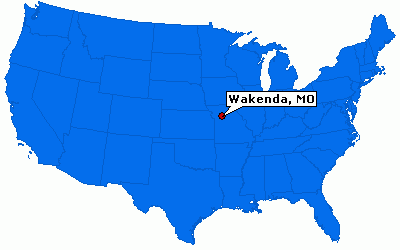
Sometimes it’s hard to know where to begin the story of one’s life. I’ve always heard though that the beginning of every journey starts with the first step.  I believe it would be impossible for anyone to understand who I am without first understanding where it is that I came from.  That place was a small town all but forgotten by the rest of the world, buried deep in the heart of the Missouri river valley. Nothing more than a wide spot in the barely paved state highway that slowed to 25 miles per hour as it crossed the exact center of nowhere.

There, tucked away in the north central part of the state, about ten miles or so from where the clear and slow moving water of the Grand River mixes with the quickly rolling mud of the Missouri River was my isolated valley. A tiny insignificant place dotted with small farms and rolling pastureland of bluestem, switch, and Indian grass. Somewhere just off the beaten path and a little left of “where the hell am I anyway”.

From high up in the hills where the Crabapple and Cottonwood creeks merge just outside Log Cabin Station there is a small creek that begins to snake its way south for thirty miles or so along the northern boundary of that rich Sugar Maple bottom land. On the burning days of summer the water in that creek moved slowly through a green and fertile landscape. Baked by the scorching sun, huge cracks appeared in the clay along its banks. Willow trees drooped in the heat; their limbs dipping down, longing for the refreshing touch of the cool silver water. Gars, carp, and catfish flipped the surface with their tails. Spreading small circles through the barely moving current. A few soft shelled turtles sprawled across logs and rocks basking in the afternoon sun. In most places it ran so shallow that as a small boy I could walk from one side to the other without getting the legs of my cutoff blue jeans wet.

In the springtime those soft clouds that drifted lazily across the blue sky could turn black. Heavy thunderstorms would roll over those loess covered shale and limestone mounds that rose above the valley. Rain fell in sheets across the thousands of acres of oak, walnut, hickory, maple, and cottonwood trees. The barrage would send silt filled water rushing down through hundreds of sloughs, branches, and springs. The tiny creek swelled until it could no longer contain itself and in a rage boiled over its banks. But the anger was usually short lived and the turbulent water would move on and pour its lifeblood into the central vein that fed the heartlands of this country. As it slowly receded into the confines of its tree lined banks it left behind another film of fertile topsoil.

In winter the tiny waterway would freeze and become dormant under a thick cover of ice. Its center would bow and crack from the heavy weight of snow. There it would wait patiently and gather its strength. Ready to burst forth and carry life again when the weather warmed and the clouds turned black.

For seven centuries this cycle had brought life to this valley and for seven centuries the ancestors of the Sioux Indians fished, hunted, and thrived there. They were the first to speak its name. The abundance of wildlife in the area led them to believe that small waterway was the ‘River of the Great Spirit’, and they called it…Wakenda.

It remained unchanged in appearance until those earliest settlers from Tennessee, Kentucky, and the Carolinas stretched their way westward from St. Louis on the heels of Lewis & Clark. The promise of prosperity brought them west and they brought with them their rifles and plows. With them too came the white man’s diseases and the most skillful of any assassin…progress. As progress settled into the valley of the Wakenda, the Great Sioux of the area had no choice but to fade away.

The men who settled the Wakenda valley had no interest in ripping down the forest and building an empire from the timber. They had no desire to slaughter every animal in sight to get rich from the fur trade. They planted their crops in the rich black gumbo and built their houses from the thick stands of hardwood. They made homes and carved out farms. They brought to life their dreams and created a legacy that would last for generations. They were hard working men and women, with solid moral character, integrity, and honesty. Like the people you’ll find in those pictures stored away in your attic or in an old family bible. Those faded black and white photos of people standing stiff in their threadbare dress clothes. With their well-worn hats shading their dark sullen stares. Their blank expressions and the heavy lines that crease their leathery skin makes your heart bleed to see that their youthfulness had been sucked from them at such an early age. You can see the years of hardship that had been ground into their tight-lipped unsmiling faces. But deep within those dark unblinking eyes you can see the sparkle of their resolve and you know that they would never give up; no one could ever beat them back and nothing could ever stop them.

*****

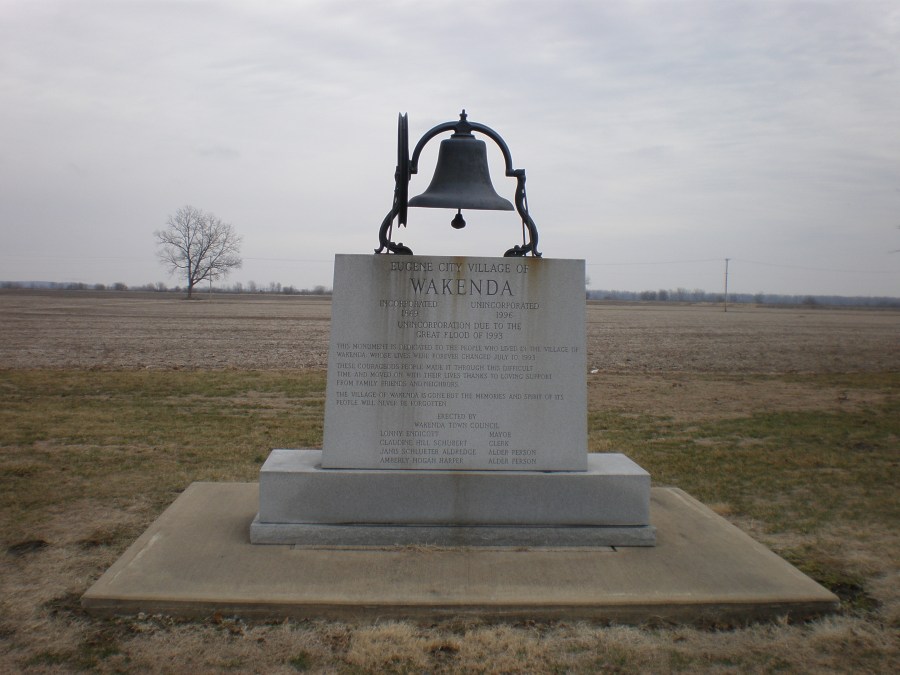
It wasn’t long after the arrival of those first settlers before progress came again. The cold steel rails of the North Missouri Railroad Company rolled across the valley carrying shop keepers, blacksmiths, and carpenters to build churches and schools. In 1869 a small settlement sprang up from the prairie grass and as it grew to become a town, it would eventually take on that same name as the creek and the valley itself. Wakenda, Missouri, ‘Home of the Great Spirit’ would thrive for a while. But eventually, like the Sioux before it, it too would be forced to succumb to the progress of time. It would struggle to survive and finally die a whimpering death.

Wakenda would be reclaimed by that same raging water that had sustained life for so many years and slowly fade away until nothing more than a pile of stones are left to mark its existence.

The Home of My Youth

Faded and long neglected

Hidden behind all the

Broken dreams of childhood

Once so crowded and loud

With so many voices

All screaming to be heard

You were so full of life

Now just a dying house

With nothing left to give